
Softcom · Useforms · 2018 – 2020
Designing for Efficient Data Collection
Useforms is a platform that makes collecting and accessing reliable data convenient — providing flexible forms that can be used to gather data anywhere, anytime. As Lead Product Designer at Softcom, I took this from 0 to 1, partnering with product and engineering to ship a platform trusted by research companies across Nigeria.
Lead Product Designer
Web App · Form Builder · Templates · Response Management
500,000+ lives impacted
Design Lead · PM · Engineering Lead · 3 FE · 1 BE · QA
The Problem
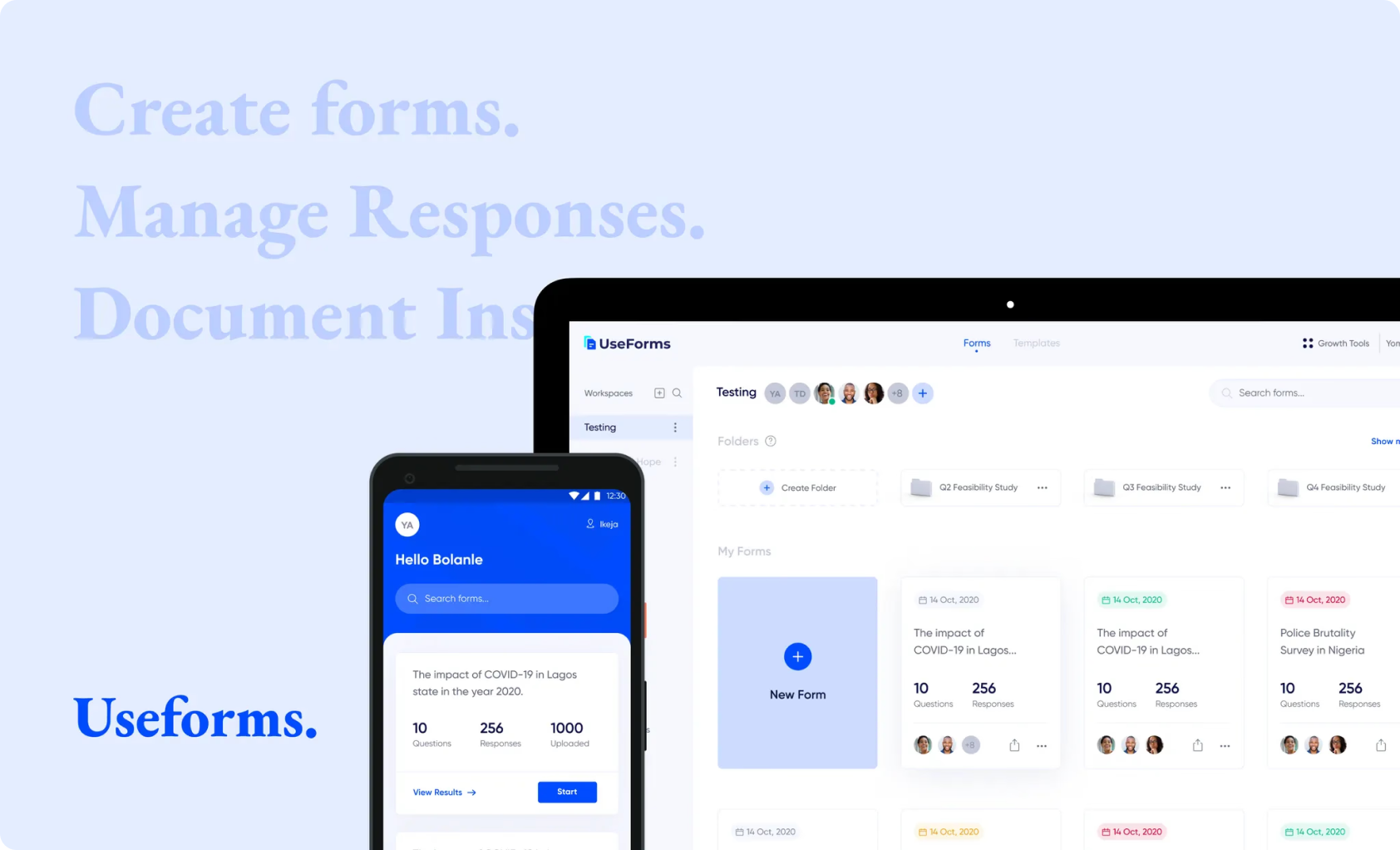
Collecting data for research companies is painstaking and time-consuming. Organizations assign agents to different locations, who move around using paper and pen. Weather, transportation, and other factors frequently lead to lost or incomplete data.
There was also the issue of validating collected data — some agents collected the same data multiple times, making it unreliable. Business owners and researchers had no trusted, scalable way to collect and verify field data.
After various sessions with users, we set out to build a solution that helps research companies collect data effortlessly — and trust the data they've collected.
What I Designed
Workspaces & Folders
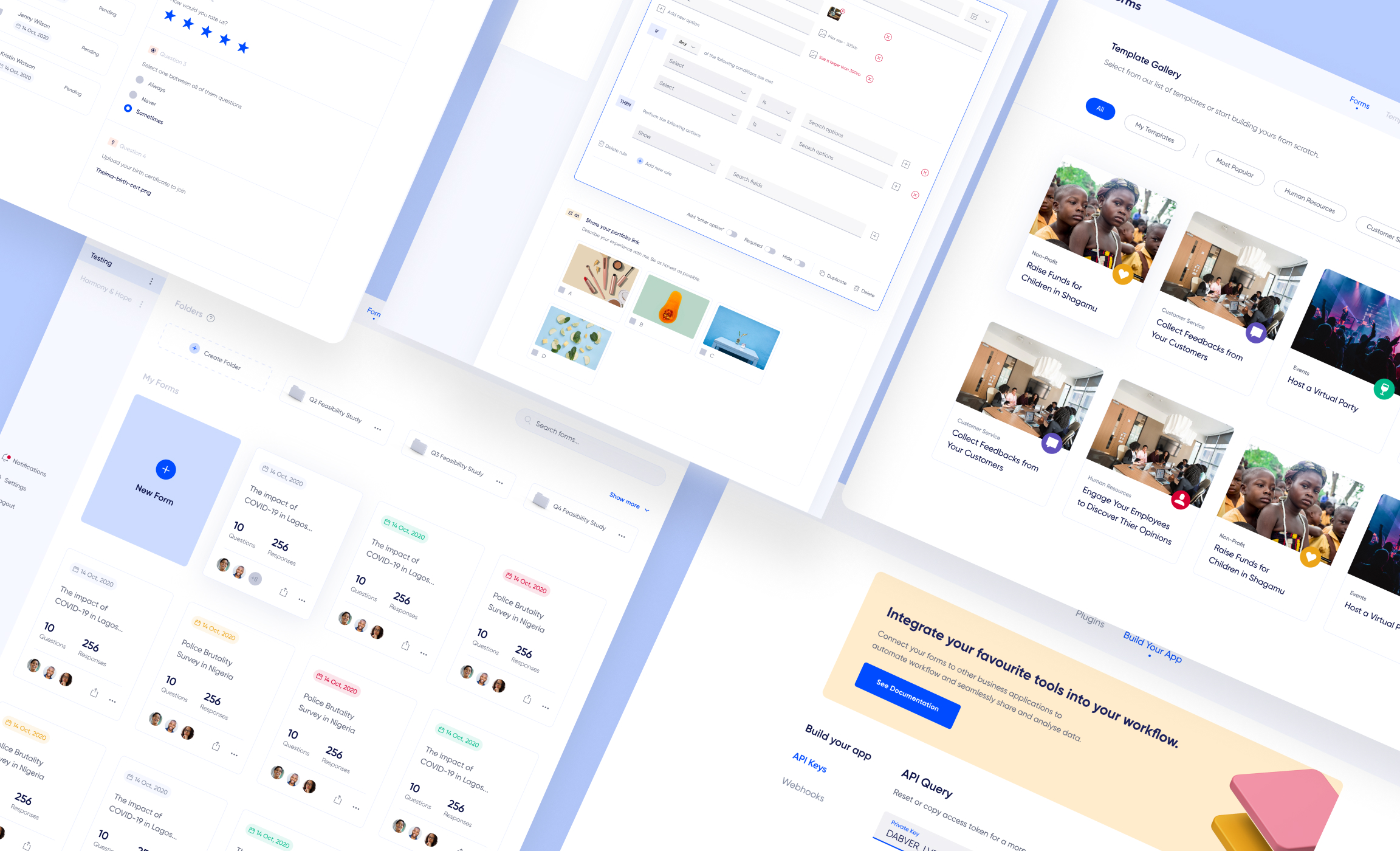
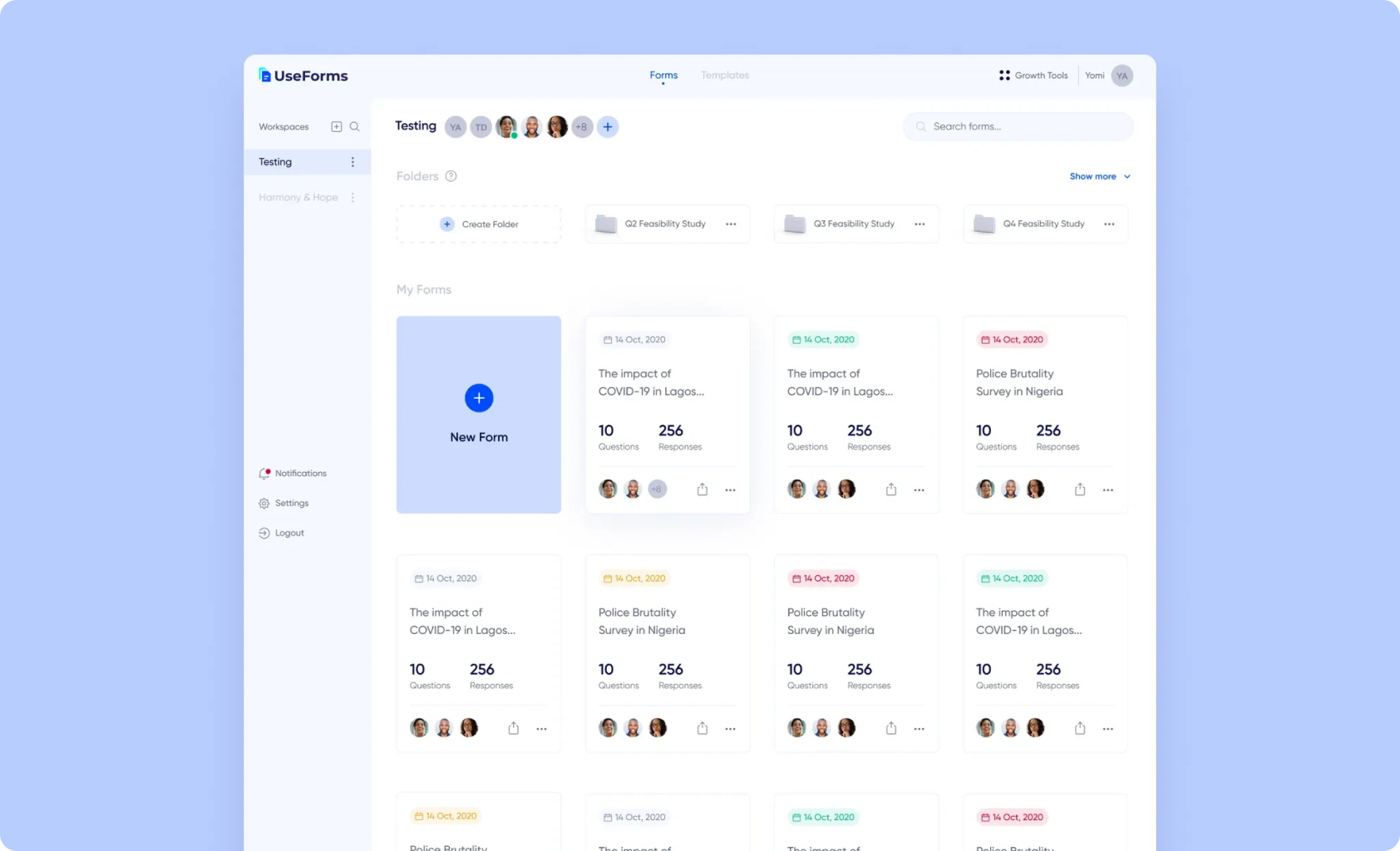
Research companies collect data for multiple organisations simultaneously. We created workspaces to separate information between different organisations, and folders to group similar forms within each workspace — giving teams a clear, structured way to manage large volumes of ongoing data collection.
Form Cards
We paid close attention to the details of form cards — surfacing response counts and question totals at a glance, a share icon for quick redistribution, collaborator management, and contextual actions — all without overwhelming the interface.
Form Builder
The form builder is the core of the platform. We ensured form elements were grouped logically so users could discover them faster. After creating a form, users can preview or share directly without leaving the builder. We also added collaborator management and conditional logic — allowing if-else rules on choice questions — making it powerful enough for complex research instruments without adding unnecessary complexity.
Templates
To reduce friction in form creation, we introduced a library of pre-built templates. When a user clicks “Create a form”, they see a list of ready-made templates alongside the option to build from scratch — eliminating the blank-slate problem and helping teams move faster on recurring research tasks.
Sharing & Distribution
Once a form is ready, Useforms generates a shareable link that can be embedded on a website or shared across platforms. For research companies, forms can be sent to specific agents via email or to organised agent groups. We also built a re-share mechanism — allowing the same form to be redistributed multiple times across different periods, helping teams collect and compare data over time without duplicating setup work.
Response Management
We designed a responses view that makes it easy to discover and validate collected data. Users can set rules to accept or reject submissions, view the location and time each response was collected — building trust in the data — and sync responses to external analytics tools like Power BI and Google Sheets for deeper analysis.
The Result
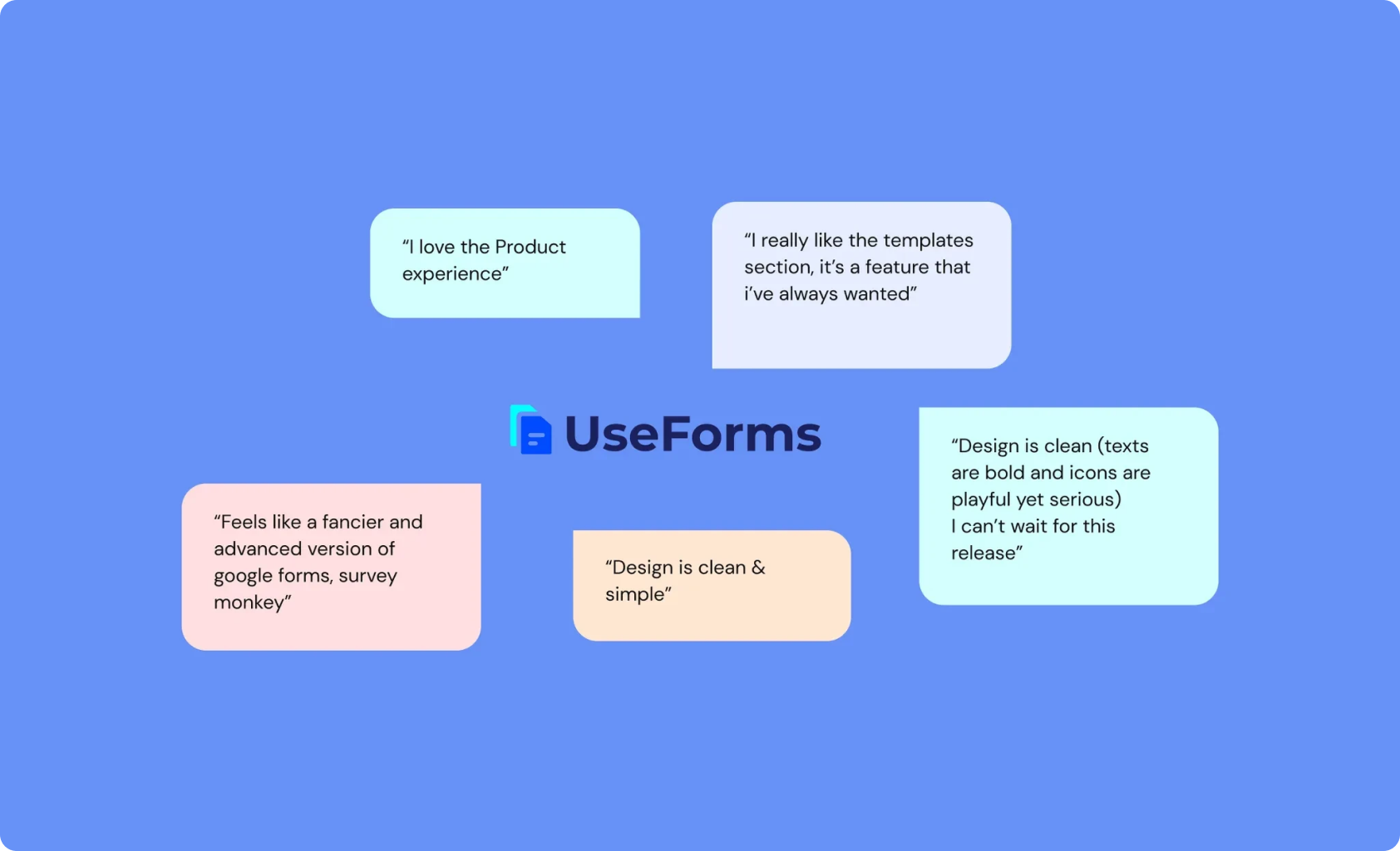
We shipped a platform with a seamless experience and a clean, accessible interface. Usability testing confirmed the approach — participants found it intuitive and significantly easier than existing alternatives.
2025 Update: Softcom has since sunset Useforms to focus on their broader platform portfolio — which has now impacted over 500,000 lives across Nigeria.
Learnings
This was a genuinely exciting project — it provides real value, involved extensive research, and required detailed interaction design. Shifting priorities and changing roadmaps delayed the launch, but the experience produced lasting lessons.
Delivering value under tight deadlines — New timelines, resourcing changes, and reprioritization meant the scope was constantly shifting. I had to adapt quickly and still deliver high-quality designs under pressure.
Choosing what to leave out — Many compelling use cases could have been tackled, but every one came at a cost. I worked closely with the PM and Engineering Lead to determine what was genuinely feasible within our timeframe.
Accessibility from the start — I came to understand how critical it is to build for people with disabilities from day one, not as an afterthought. This is something I now enforce from the very beginning of any project.
Always design responsively— We didn't ship a strong responsive view on this project due to time constraints — a gap I learned never to accept again on future platforms.
Scope changes are inevitable. Ship what matters, validate early, and design accessibly — even when time is tight.